
You don’t need to spend real money to build a Brainrot collection. In SAB: Brainrots, players can steal Brainrots from other players or join active events to get them for free; buying a Brainrot when it appears on the conveyor uses in-game cash. The game has eight rarities, from Common to OG, so income and trading value can vary sharply between items.
A rare-looking Brainrot isn’t automatically the best choice for your next move. Compare its purchase cost, cash-per-second income, rarity, and any mutation before deciding whether to keep it, trade it, or pursue another one.
This guide covers free ways to get Brainrots, compares sample purchase prices with income, and explains what affects trading value. It also summarizes the rarity tiers and mutations, helping you spot what matters before your next steal or trade.
Key Takeaways
- Use income per second alongside rarity to judge a Brainrot’s usefulness, rather than relying on appearance alone.
- Factor mutations into income comparisons: Gold multiplies base income by 1.25, while Rainbow multiplies it by 10.
- Compare in-game purchase costs with earning potential to decide whether a conveyor pickup fits your progress.
- Trading value depends on more than income. Rarity, mutations, and demand can all affect what another player may offer.
- Learn how stealing, conveyor purchases, and active events create different paths to growing your collection without spending real money.
How to get free Brainrots in Steal a Brainrot?
Free Brainrots are characters you gain without spending real money. In Steal a Brainrot, the practical routes are stealing from other players and joining active events. You can also buy conveyor Brainrots with in-game cash, without making a real-money purchase.
The rarity ladder groups Brainrots into eight tiers, ordered from Common through OG. Use the tier as a quick comparison, then check the character’s income and any mutation before deciding what to pursue.
- Common is the first named rarity tier. Treat it as an entry point for learning how collecting and income work.
- Rare is the second tier in the listed rarity order. Compare individual characters rather than relying on the label alone.
- Epic follows Rare in the tier sequence. Check its income before choosing it over a different character.
- Legendary sits above Epic in the named progression. Its tier gives context, but doesn’t replace an income comparison.
- Mythic follows Legendary. Review its mutation and traits as well as its rarity.
- Brainrot God is the next named tier after Mythic. Consider both its earning potential and what you’d risk pursuing it.
- Secret comes after Brainrot God in the listed order. Compare its full setup, not just its name.
- OG is the final tier in this eight-rarity sequence. A high tier alone doesn’t tell you the character’s complete value.
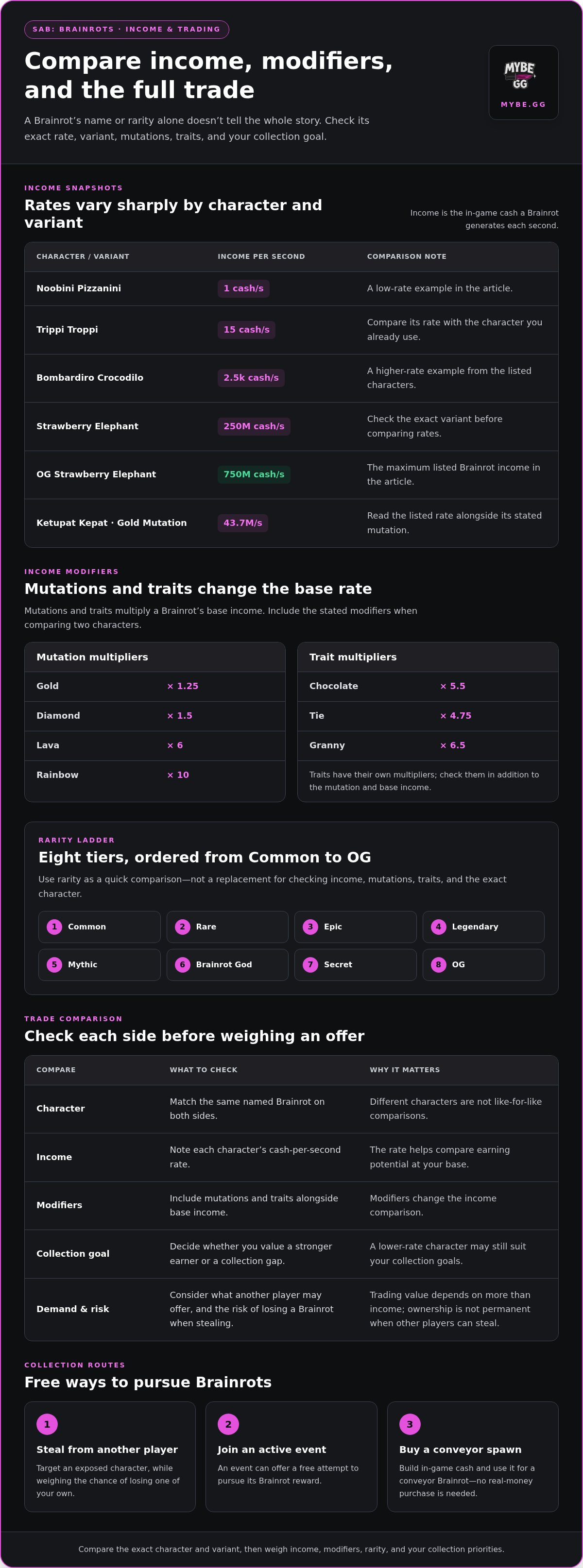
Mutations and traits are modifiers that multiply a Brainrot’s base income. Gold uses a 1.25 multiplier, Diamond 1.5, Lava 6, and Rainbow 10; traits also have multipliers, including Chocolate at 5.5, Tie at 4.75, and Granny at 6.5.
Losing Brainrots is a risk built into stealing: another player can take a Brainrot from you. Consider that risk before pursuing a steal, and remember that collecting a character doesn’t make ownership permanent.
Brainrot slots are spaces for characters at your base. Use the in-game base upgrade prompts to expand capacity, then prioritize placements by income so your strongest earners occupy available slots.
For a free attempt, watch for an active event, then join to pursue its Brainrot reward. You can also target an exposed character at another player’s base, but weigh the potential gain against the chance of losing one of your own. For a more predictable route, build in-game cash and buy a conveyor spawn instead.
Brainrot income and trading values
Income per second is the in-game cash a Brainrot generates each second. In SAB: Brainrots, use this rate to compare earning potential, but check the exact character and variant too. Noobini Pizzanini produces 1 cash per second, while Trippi Troppi produces 15. That difference can help you decide which character to keep earning at your base.
Trading value is what players consider a Brainrot worth when weighing an exchange. Compare the character, its income, mutation, and traits before judging an offer. The character’s name alone won’t tell you everything that may affect its usefulness.
Check the range across the listed examples. Bombardiro Crocodilo generates 2.5k cash per second, while Strawberry Elephant generates 250M per second. The OG Strawberry Elephant entry reaches 750M per second, the maximum listed Brainrot income. Exact character and variant details matter when comparing rates.
A mutation is a variant that multiplies a Brainrot’s base income. Multiply the base rate by the mutation multiplier to compare adjusted income. Traits are additional modifiers with their own multipliers. Include both when assessing Brainrots, rather than comparing base rates alone.
Use these checks before accepting an offer:
- Match the character: Compare the same named Brainrot on both sides, not different characters.
- Compare income: Note each character’s cash-per-second rate.
- Check modifiers: Include each Brainrot’s mutation and traits in your comparison.
- Assess your goal: Decide whether you value a stronger earner or a character that fills a collection gap.
When stealing, weigh the potential gain against the risk of losing one of your own Brainrots. For a trade, compare the characters’ full details before agreeing. Treat exposed characters as vulnerable, especially if losing one would affect your income setup.
Don’t treat unlike entries as identical. Strawberry Elephant’s listed 250M and OG 750M per-second rates show why checking variant details matters. If an offer leaves out income, mutation, or traits, the character name alone won’t give you a like-for-like comparison.
A useful SAB: Brainrots trade check starts with income, then considers modifiers and collection value. A lower-rate character may still suit your collection goals, while a higher earner can support in-game progress. To compare available items against your setup, browse Steal a Brainrot items.
Listings can provide a useful reference when comparing income, but keep each entry’s stated details attached to the character. Listings can describe a Brainrot’s income, but that figure should be read alongside its variant information. A Ketupat Kepat listing for Steal a Brainrot is described as 43.7M/s with a Gold Mutation. These examples show why a rate should be read alongside the listing’s variant information, rather than treated as a complete measure of trade value.
When checking an offer, compare the listed income and any stated mutation as separate details. If information differs between entries, don’t assume the characters are equivalent based only on their names or rates. A clear comparison helps you judge whether an exchange supports your income setup or collection goals, while leaving room for the features you value most.
Brainrot purchase prices
A purchase price is the amount of in-game cash needed to buy a Brainrot. These figures are game-cash costs, not real-world prices. The examples below show a sharp progression from a low-cost starter to a high-cost character.
Noobini Pizzanini costs 25 in-game cash, while Trippi Troppi costs 2k. Bombardiro Crocodilo costs 500k, and Strawberry Elephant costs 500B. Compare the exact character names before spending. Similar-sounding names or different variants should not be treated as interchangeable prices.
- Noobini Pizzanini: 25 in-game cash.
- Trippi Troppi: 2k in-game cash.
- Bombardiro Crocodilo: 500k in-game cash.
- Strawberry Elephant: 500B in-game cash.
Affordability means having enough in-game cash for the listed purchase. Start by comparing your balance with the character’s cost. If you’re targeting Bombardiro Crocodilo, use its 500k cost as the target. Strawberry Elephant’s 500B cost sits far above the other examples.
Make a shortlist before spending. First, choose the Brainrot you want. Compare its listed cost with your available cash, then decide whether to buy it or keep saving for another target. This helps prevent a low-cost purchase from distracting you from a specific goal.
Cost progression describes how the listed prices rise between examples. Noobini Pizzanini at 25 and Trippi Troppi at 2k give you lower-cost reference points. Bombardiro Crocodilo at 500k and Strawberry Elephant at 500B show how far apart character costs can be. Don’t assume the next character in a collection follows a small price increase.
Compare purchase cost with income when weighing your options. A higher price alone doesn’t tell you how quickly a Brainrot earns cash. Check the exact character and its income rate, then weigh the purchase against your current aim. For example, compare the cash needed for Bombardiro Crocodilo with the income it generates before deciding whether it fits your plan.
These four prices are reference points, not a complete price list. They cover Noobini Pizzanini, Trippi Troppi, Bombardiro Crocodilo, and Strawberry Elephant. For each target, keep the unit clear: the figures here mean in-game cash. Don’t confuse them with real-world currency or treat an in-game cost as a cash price.
Ready to buy? Choose your target first, then compare its cost with your balance and income goal. A clear target makes each purchase easier to assess.
Treat these as listing prices, not purchase costs inside the game.
Ways to get free Brainrots
A free Brainrot is one gained through gameplay without spending real money. In Steal a Brainrot, focus on three routes: take a conveyor spawn using in-game cash, steal from another player, or participate in an active event. Each route uses a different resource: cash, timing, or event participation.
A conveyor spawn is a Brainrot that appears for players to buy with in-game cash. This route avoids real-money spending, but you still need enough cash for the character. Watch the conveyor, identify the Brainrot you want, and compare its cost with your balance before buying. Saving for a specific target can help you avoid spending on a different spawn.
Stealing means taking a Brainrot from another player’s base. The map has 8 bases, so check nearby bases for a character worth pursuing. Choose your target based on the Brainrot you want, then make your move when the opportunity appears. Stealing costs no real money, but it carries the risk of losing a Brainrot yourself. Weigh that risk against the character’s value to your collection.
An active event is a limited gameplay opportunity where participating can help you obtain Brainrots. Molten Events happen roughly every 2 hours, giving you a recurring event to watch for. When a Molten Event is active, join in and follow its in-game activity. Focus on the event rather than splitting your attention between it and unrelated collection goals.
Use this quick plan to choose your route:
- Need a specific character? Watch conveyor spawns and save in-game cash for its listed cost.
- Ready to take a risk? Look across the 8 bases for a steal target that suits your collection.
- Want an event route? Watch for a Molten Event, which occurs roughly every 2 hours.
Keep your goal clear. A conveyor purchase gives you a direct choice, while stealing depends on another player’s base. Events offer another gameplay route. None of these methods requires a real-money purchase, but each has a different condition: enough in-game cash, a chance to steal, or an active event to join.
For a practical routine, pick one route before you play. Save cash if you’re targeting a conveyor character. Check the map if stealing fits your plan. Watch for Molten Events if you prefer event participation. Choosing a route helps you spend less time switching plans and more time pursuing the Brainrot you want.
What are Brainrots in SAB, and how do you get them?
Brainrots are collectible characters in Steal a Brainrot that players acquire and use to generate in-game cash. The game includes 408 Brainrots, giving players a broad collection to build. Each character has its own name and income rate, so compare the exact character rather than treating every Brainrot as interchangeable.
The conveyor is the in-game route where players can buy Brainrots with game cash. According to Wikimedia Foundation, players acquire Brainrots by purchasing them from the conveyor or stealing them from other players. Watch for a character you want, compare its displayed cost with your balance, then decide whether to buy it or keep saving.
Stealing means taking another player’s Brainrot rather than buying a conveyor spawn. According to Wikimedia Foundation, this is another way to obtain characters. Before targeting one, consider its income and how much you value it in your collection. Stealing can also put your own Brainrots at risk, so weigh the possible gain against what you could lose.
Rarity is the tier label that groups Brainrots by category. Steal a Brainrot has eight tiers: Common, Rare, Epic, Legendary, Mythic, Brainrot God, Secret, and OG. Use these names to sort and compare characters, but don’t rely on rarity alone. A character’s individual income and your collection goal matter too.
Income per second is the amount of in-game cash a Brainrot generates each second. Noobini Pizzanini produces 1 cash per second, while Trippi Troppi produces 15. Those examples show why the character name and its specific rate matter when choosing what to pursue. A higher rarity label alone doesn’t tell you the income figure.
Use this quick comparison process before you act:
- Name your target: Choose a specific character from the 408 Brainrots.
- Check its tier: Identify whether it is Common, Secret, OG, or another listed rarity.
- Compare income: Use the character’s cash-per-second rate to assess its earning role.
- Pick a route: Buy from the conveyor with in-game cash, or pursue a steal from another player.
That process keeps the decision focused on the character, its income, and how you can obtain it. If you want to add characters through a separate purchase route, browse Steal a Brainrot items.
MybeGG: Murder Mystery 2 items
MybeGG gives players a direct way to browse game items when they want an option beyond earning everything in-game. For Steal a Brainrot, compare the available items with your collection goals and the characters you’re trying to add. MybeGG also offers Murder Mystery 2 items and Adopt Me items, so you can browse by game instead of mixing up different item markets.
Use the guide’s income, rarity, and mutation checks to decide what fits your SAB collection. MybeGG advertises instant in-game delivery for purchases, with listings organized by game. Browse the relevant items, then decide whether a purchase suits your plan or you’d rather keep collecting through gameplay.
Visit mybe.gg to explore the available game items.
Make your next collection move
To build your SAB: Brainrots collection, decide what matters most: filling a gap, working toward a favourite, or exploring a new game. Set a clear goal before you act. This helps you choose whether to keep earning in-game or browse items that match your interests. You don’t need to chase every character at once. Pick the move that suits your playstyle.
If you want to browse beyond your current collection, MybeGG offers Steal a Brainrot items, Murder Mystery 2 items, and Adopt Me items. Choose the game you’re focused on, then explore the relevant listings at your own pace.
Explore Steal a Brainrot items and find a next step that fits your collection goals. Keep playing your way, and enjoy building a collection that feels like yours.
Frequently Asked Questions
What Brainrot characters or rarities are available in SAB?
Steal a Brainrot has 408 characters across eight rarity tiers: Common, Rare, Epic, Legendary, Mythic, Brainrot God, Secret, and OG. Rarity and character identity are separate details, so check both when comparing entries. Mutations add another layer: Gold, Diamond, Rainbow, and Galaxy are four familiar variants. A character’s displayed name, tier, and mutation together give you a clearer way to identify what you’ve collected.
How do you earn coins or currency from Brainrots in SAB?
Brainrots earn in-game cash over time, with each character producing its own amount per second. To estimate a character’s contribution, multiply its displayed rate by the time it remains active at your base. Mutations can raise its base income: for example, Rainbow applies a 10x multiplier. Compare the resulting rate with your next purchase goal, then decide whether to keep that Brainrot earning or pursue a different character.
What are the current Brainrot prices and sell values in SAB?
In-game purchase examples range from 25 cash for Noobini Pizzanini to 500B for Strawberry Elephant. Trippi Troppi costs 2k, while Bombardiro Crocodilo costs 500k. These are game-cash amounts, not real-world prices. For a trade or sale comparison, assess the exact character, its income, and its modifiers; those details affect what another player may consider valuable. Don’t treat a purchase cost as a guaranteed resale value.
Which Brainrots are best for income or progression in SAB?
For maximum listed income, Strawberry Elephant OG leads at 750M cash per second. For a progression target, compare that rate with what you can realistically pursue and use each character’s income to build toward your next goal. Mutations can change the calculation: Rainbow multiplies base income by 10, while Gold multiplies it by 1.25. Check the full character and variant details before prioritizing an upgrade.
How do you unlock and upgrade Brainrot slots or storage in SAB?
Brainrot slots are spaces for characters at your base. Use the in-game base upgrade prompts to expand your capacity.
What does “SAB” mean in the context of Brainrots?
SAB means Steal a Brainrot.


مشاركة:
Buy MM2 Knives Online: A Clear Shopping Guide for 2026
Buy MM2 Guns: A Safer, Smarter Guide to Choosing and Checkout